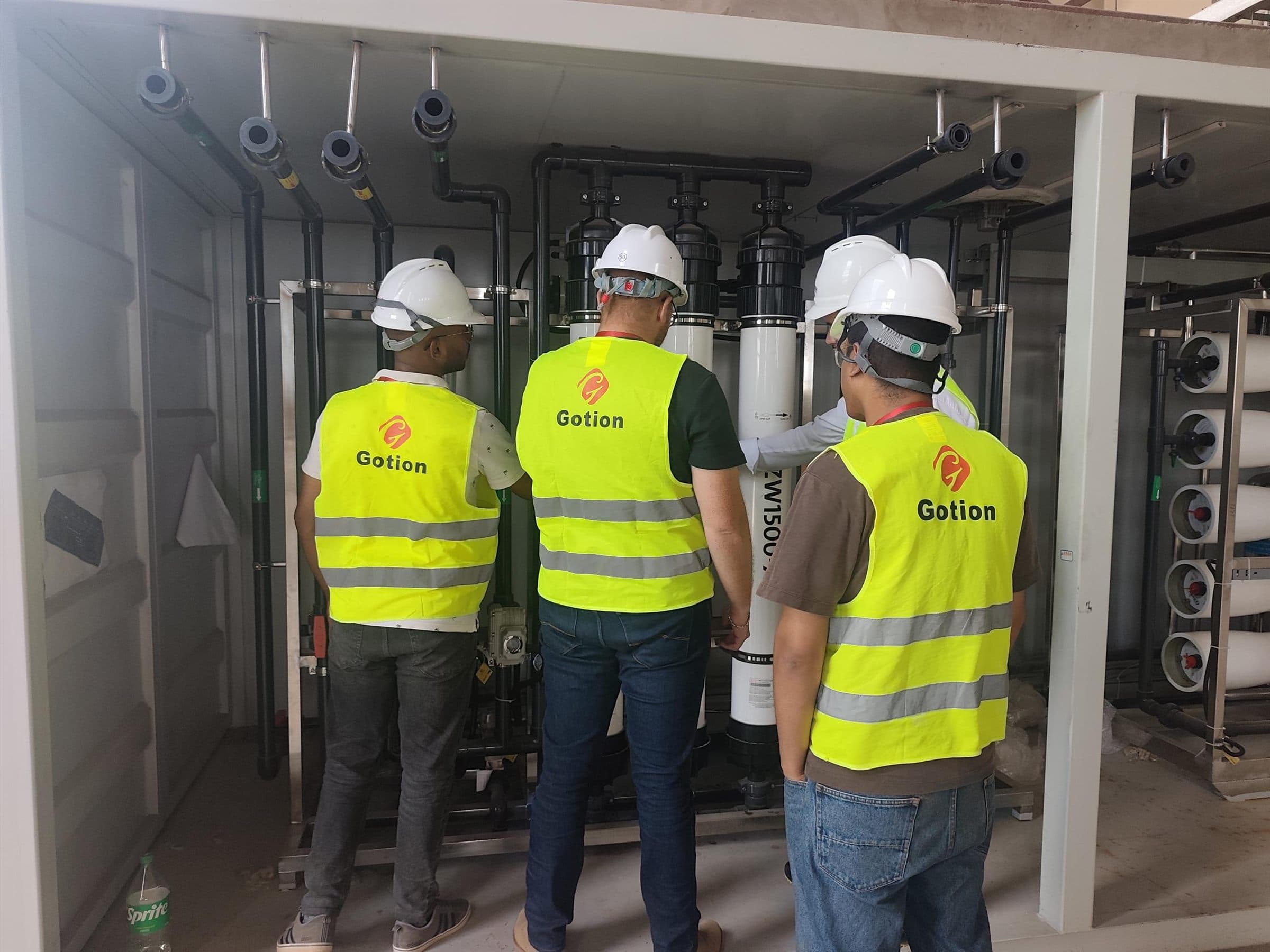
A containerized pure water system is a delivery format, not a complete specification. It can reduce field assembly and simplify shipment coordination, but the process route, utilities, climate protection, access, lifting, installation interfaces and commissioning plan still need to be defined for the destination site.
Containerization is a project decision, not just a packaging choice
Containerized water treatment systems are often considered for overseas projects because they can consolidate equipment, piping, controls and internal wiring into a transportable module. This can reduce the amount of site assembly compared with a loose skid package, especially when the destination has limited fabrication resources or a tight installation window.
However, a container does not remove engineering decisions. The buyer still needs a correct treatment process, a suitable incoming-water connection, drain route, electrical supply, ventilation, chemical-handling approach, service access and distribution interface. A container that is easy to ship but difficult to operate or maintain at site is not a successful solution.
At the earliest stage, decide whether the system must fit within standard transport dimensions, whether it will be located indoors or outdoors, and whether it must operate in high ambient temperature, cold conditions, dust, humidity or corrosive surroundings. These factors influence enclosure design, insulation, HVAC, lighting, drainage, materials and electrical protection.
- Confirm transport route, container size limits and final lifting method.
- Define outdoor/indoor location and ambient design conditions.
- Reserve access for membrane replacement, pump service and panel opening.
- Confirm whether storage and distribution are inside or outside the container scope.
Lock the water-treatment basis before the container layout
The process should be selected from feed-water analysis, target quality, capacity and operating profile. It may include pretreatment, single-pass RO, double-pass RO, EDI, UV, storage and distribution depending on the application. The layout must follow the process—not the other way around. Trying to force an undefined process into a fixed footprint often leads to inadequate maintenance space or omitted auxiliaries.
For pure-water projects, specify water quality at the defined handover point. That may be the container outlet, a product tank outlet or a point of use. State the relevant limits, measurement method and normal operating conditions. Where the final requirement depends on a production process still under development, identify a provisional design basis and a formal point for confirmation before release for fabrication.
The scope should clearly separate system generation from distribution. A container can generate the water successfully while a poorly specified external tank, piping loop or booster set prevents the factory from receiving the intended quality and pressure.
- Recent feed-water analysis and source description
- Required quality at a stated sampling point
- Peak flow, daily volume and operating profile
- Process boundaries for treatment, storage, distribution and drainage
| Interface | Confirm before release | Project owner |
|---|---|---|
| Utilities | Water, power, drain and ventilation | Site / EPC |
| Civil and lifting | Foundation, access and lifting route | Site / EPC |
| Documentation | FAT, drawings, manuals and packing list | Supplier / buyer |
Send the feed-water analysis, target quality, required capacity and operating profile. We will help structure the next engineering questions.
Send your project inputsDefine utility and civil interfaces in a site-ready schedule
Overseas installation often fails at the interfaces rather than inside the equipment. A site utility schedule should list incoming raw-water pressure and connection size, electrical voltage/frequency, compressed air if used, drain requirements, ventilation loads, chemical handling, floor loading and data/communications connections. Every item needs an owner: site contractor, EPC, electrical contractor or water-system supplier.
Civil information is equally important. Confirm the foundation or slab, level tolerances, drainage fall, access route, door clearance, crane or forklift plan and any seismic or wind anchoring requirements. Where the container will be placed outdoors, include weather protection, sun exposure, rainwater management and insulation requirements in the specification instead of assuming a standard shipping container is sufficient.
Installation preparation should also cover external piping. Specify material, flange or union standards, insulation, supports, flushing responsibility and connection locations. A simple connection drawing with coordinates can prevent days of rework on site.
- Utility list with normal and maximum values
- Civil and lifting plan for delivery day
- External-piping material and connection standards
- Drain, overflow and reject-water management
Design for maintainability, safety and operator workflow
A compact module must still allow people to work safely. Review door swing, aisle width, lifting route for consumables, membrane extraction, cartridge replacement, chemical access, eyewash provisions where chemicals are handled, lighting, emergency stop access and local isolation valves. Ask an operator to walk through the proposed general arrangement before fabrication.
Chemical dosing and cleaning systems require particular attention. The specification should identify chemical storage, bunding or containment, filling procedure, venting, labeling, material compatibility and waste handling. If the project will not maintain concentrated chemicals on site, that choice changes the available treatment and cleaning options.
Controls should make normal operation understandable. At minimum, the operator should be able to see flow, pressure, conductivity and alarm state, with a clear distinction between process alarms and maintenance reminders. Remote monitoring may be useful, but it should not replace local safe operation or a written response procedure.
- Service access verified on the GA drawing
- Chemical and CIP safety scope defined
- Local instruments, alarms and sample points identified
- Operating manual and spare-parts list aligned with the destination site
Use FAT and shipment inspection as control gates
For a containerized system, factory acceptance testing should review both process function and delivery readiness. The exact test depends on available water and project scope, but it can include piping completion, tag checks, panel function, pump rotation, instrument signals, alarms, interlocks, internal lighting, ventilation, drain routing and available operating run data. If actual site water is not available, say so explicitly in the FAT record rather than presenting test-water results as final site performance.
Shipment inspection should confirm preservation, loose items, spare parts, documents, lifting markings, packing list, shipping restraints and external condition. Photographing the internal arrangement, control panel, membrane vessels and connection labels before shipment provides useful evidence for installation teams who may receive the equipment weeks later.
The required documentation should be agreed before FAT: P&ID, GA, electrical drawings, instrument list, I/O list, manuals, recommended consumables, packing list, FAT report and any inspection release. This is more reliable than trying to reconstruct information after the module has left the factory.
- Agree FAT checklist and acceptance rules before test date.
- Record exceptions and close-out responsibility.
- Inspect delivery restraints and preservation for sea freight or long storage.
- Issue a controlled document package for site installation.
Commissioning begins before the container arrives
Commissioning is smoother when the site completes a readiness review before delivery. Confirm utilities, drainage, external piping pressure test, electrical termination, consumables, chemical availability, water sampling plan and operator attendance. A project may also need local permits, lifting supervision or commissioning water disposal arrangements.
At startup, record feed-water conditions and baseline performance. Verify the treatment sequence, flushing, product-water routing, reject routing, tank levels, alarms and interlocks. Sample at the agreed points and compare results against the written design basis. If performance differs, investigate feed-water variation, temperature, instrument calibration, valve alignment and external piping before assuming an internal equipment fault.
The final handover should include operator training, a preventive-maintenance plan, spare-parts recommendation and a clear contact route for technical questions. These ordinary project controls are what turn a shipped container into a sustainable water supply for the factory.
- Complete a site-readiness checklist before delivery.
- Record baseline pressures, flows and quality after stable operation.
- Train operators on normal operation, alarms and preservation.
- Keep FAT, commissioning and water-sample records together for future troubleshooting.
Questions buyers commonly ask
Can a containerized pure water system be installed outdoors?+
Yes, when the enclosure, ventilation, insulation, weather protection, drainage and electrical design are specified for the local environment. It should not be assumed without reviewing the site climate.
Does the container include storage and distribution?+
It can, but this must be defined. Many projects locate the product tank or distribution pumps outside the module, so the process boundary and interfaces must be clear.
What should be checked before shipment?+
Confirm FAT completion, equipment tags, loose items, documents, spare parts, preservation, packing list, restraints, lifting marks and the installation interface drawings.
What is needed before commissioning?+
Site utilities, drainage, external piping, power, water-sampling plan, consumables, operator availability and a clear installation-completion record should be ready.
Turn the guide into a project brief.
Final process selection and performance commitments should follow the complete feed-water analysis, application requirements, site utilities and approved technical agreement.