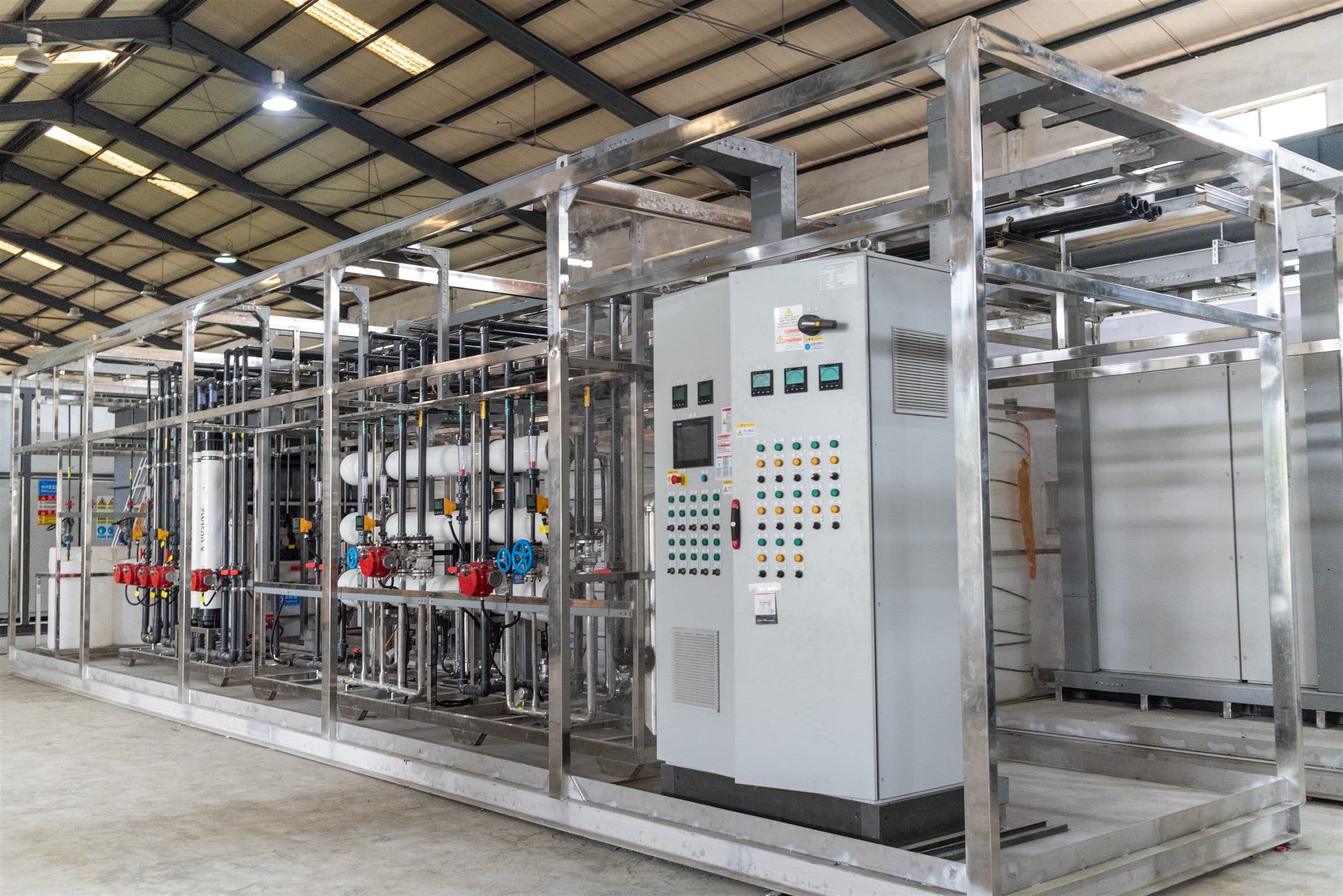
Industrial RO sizing is a water-balance and risk-management exercise. Start with the point-of-use demand profile, then work backwards through storage, distribution, RO permeate flow, recovery, feed flow and pretreatment. A quoted m³/h figure is incomplete unless its temperature, feed-water quality and recovery assumptions are stated.
Begin with demand at the process, not the nameplate
The first sizing question is not ‘How many cubic metres per hour?’ It is ‘When, where and at what quality will the process consume water?’ A facility may need a steady base load, short high-flow rinse events, batch make-up water or a combination. The RO skid, storage tank and distribution pump set must work together to serve that pattern.
Separate average consumption from peak demand. A system sized only to average demand may appear inexpensive but rely on an impractically large tank or create pressure and quality fluctuations during production peaks. Conversely, a skid sized for every short peak without storage can be unnecessarily large. The right balance depends on operating hours, allowable tank residence time, redundancy needs and how quickly production can tolerate interruption.
For an initial RFQ, provide peak flow, daily volume, shifts per day, operating days per year and any planned expansion. If those data are uncertain, state the range. A transparent uncertainty is more useful than a precise-looking estimate that later proves wrong.
- Point-of-use peak flow and daily demand
- Operating hours, batch cycles and future expansion
- Required pressure and quality at the use point
- Permitted storage volume and any hygiene or residence-time constraints
Use the water balance to connect permeate, feed and reject
RO recovery is the ratio of permeate flow to feed flow. It is a key design variable because it determines reject flow, concentrate chemistry, pump duty and water consumption. Higher recovery may reduce feed-water use, but it also concentrates sparingly soluble salts and can increase scaling, fouling or cleaning risk. The correct recovery is therefore established from the feed-water analysis and pretreatment strategy, not selected from a generic marketing chart.
For example, if a process requires 10 m³/h of RO permeate and the proposed recovery is 70%, the feed flow is approximately 14.3 m³/h and the reject flow approximately 4.3 m³/h before allowing for flushing and auxiliary consumption. Those flows must be compatible with the incoming-water system and drain or recovery plan. The calculation is simple; choosing a defensible recovery is the engineering work.
Temperature also matters. Membrane permeate flow changes with temperature, while salt passage and pressure requirements are affected by feed conditions. A proposal should clarify whether stated capacity refers to a nominal temperature, a minimum expected temperature or a normalized condition. This is particularly important where seasonal raw-water temperature changes significantly.
- Permeate flow = required treated-water production.
- Feed flow is calculated from permeate flow and recovery.
- Reject routing must be designed as a utility, not left as a late-stage question.
- Nominal capacity needs a stated temperature and feed-water basis.
| Input | Why it matters | Confirm with |
|---|---|---|
| Peak and daily demand | Sets production and storage duty | Production schedule |
| Feed-water analysis | Sets pretreatment and recovery | Representative laboratory result |
| Target quality | Selects RO and polishing route | Use-point specification |
Send the feed-water analysis, target quality, required capacity and operating profile. We will help structure the next engineering questions.
Send your project inputsPretreatment is part of RO sizing
Membranes cannot be sized responsibly without defining what reaches them. Suspended solids, colloids, hardness, iron, manganese, oxidants, organics, biological activity and silica can each affect the pretreatment train. The treatment route may include filtration, activated carbon, softening, dosing, ultrafiltration or multiple barriers. Which one is appropriate depends on the analysis, source stability and the operational capability of the site.
A common procurement mistake is to compare only the membrane rack while treating pretreatment as an optional add-on. This can understate capital cost and create a system with weak protection against the actual feed. The correct scope should show sampling points, pretreatment outlet targets, cartridge filtration, dosing points, chemical storage requirements and control interlocks.
Ask how the supplier will validate the design assumptions. For municipal water, a current analysis may be enough for an initial proposal but seasonal utility variation still matters. For well water, surface water or reclaimed streams, a wider set of samples and operating history may be necessary. If the analysis is incomplete, the proposal should identify what must be confirmed before final membrane selection.
- Send laboratory results with collection date and source description.
- Report chlorine or oxidant treatment, turbidity and known seasonal changes.
- Clarify whether raw water is municipal, well, surface, process or reclaimed water.
- Request pretreatment performance targets and monitoring points.
Select membranes and pumps with operating margin
Membrane selection balances active area, flux, salt rejection, pressure drop, cleanability and available pump pressure. Higher flux may reduce the number of elements, but it can also increase fouling sensitivity for a challenging feed. Lower-flux design can be more conservative in some industrial applications. A fair comparison therefore includes the proposed flux range, element count, vessel arrangement and expected recovery—not only the total rated flow.
Pumps should be selected for the realistic duty point, including membrane feed pressure, pretreatment pressure loss, pipe loss, temperature and a reasonable allowance for membrane ageing. Variable-frequency control may be useful where demand or feed conditions change, but it needs a clear control strategy and minimum-flow protection. Electrical supply, starting method and enclosure requirements must be aligned with the project location.
Instrumentation is essential to sizing validation. Flow meters, pressure transmitters, conductivity measurement, pH where relevant and sampling valves allow operators to understand whether the system is performing as designed. A low-cost skid with too little instrumentation is difficult to commission and even harder to troubleshoot.
- Ask for membrane array and nominal design flux.
- Review high-pressure pump duty, material and motor assumptions.
- Confirm what signals are trended or alarmed in the control system.
- Include CIP connection, flushing and preservation requirements in the specification.
Size storage and distribution as a separate subsystem
An RO skid produces water at one rate; users often consume it at another. Storage is the buffer between those two rates. The tank volume should be derived from peak events, required reserve and water-quality considerations, not selected by a rule of thumb. For higher-purity applications, tank material, vent filtration, overflow arrangement, recirculation and cleanability deserve as much attention as volume.
Distribution pumps need to provide the required pressure at the farthest point of use under the actual pipe layout. A loop may be needed where consistent quality and hydraulic turnover matter. Consider standby pumping, drainability, sample points and whether the process needs constant pressure or only a local day tank. These decisions are usually easier and less expensive when made before the skid layout is frozen.
The final water-quality target should be checked after the distribution route is considered. Materials, stagnant branches and poorly controlled storage can change the quality seen by the user even if the generation skid operates correctly.
- Define tank working volume, reserve volume and overflow route.
- Specify point-of-use pressure, pipe length and elevation.
- Avoid dead legs where water quality or microbiological control is important.
- Include commissioning samples at the skid and at representative points of use.
Build an RFQ that suppliers can quote honestly
A useful RFQ does not force every supplier to guess. It identifies what is known, what is still to be confirmed and which conditions are critical. At minimum, include water analysis, production rate, operating schedule, target quality, project country, electrical supply, installation environment, preferred materials, documentation requirements, inspection expectations and delivery target.
Request a process description and P&ID, equipment list, utility list, general arrangement, control scope and list of exclusions. These documents reveal whether two quotations are truly comparable. If a supplier proposes a different recovery, pretreatment route or design flow, ask for the technical reason rather than treating the difference as an automatic error.
Factory testing and shipment inspection should be part of the project schedule. An agreed FAT checklist helps confirm assembly, panel function, instrument tags, alarms and available performance checks before packing. It does not replace site commissioning, but it creates a documented starting point for delivery and installation preparation.
- State the design basis and accepted deviations.
- Ask for a list of process assumptions alongside the quotation.
- Define FAT witness, documentation and shipment-inspection requirements early.
- Plan commissioning utility readiness before equipment arrival.
Questions buyers commonly ask
What information is needed to size an industrial RO system?+
Provide feed-water analysis, required permeate flow and daily volume, product-water quality, operating profile, installation location, available utilities, reject route and future expansion plan.
How is RO recovery selected?+
Recovery is selected from feed chemistry, scaling and fouling risk, pretreatment performance, membrane design and concentrate handling. It should not be copied from another project without review.
Should an RO system include a storage tank?+
Often yes, because process demand and RO production are rarely identical. The tank and distribution system should be sized from the demand profile and quality needs.
Why do two suppliers quote different RO capacities?+
They may be using different temperature, recovery, feed-water, membrane, peak-demand or storage assumptions. Ask both suppliers to disclose their design basis.
Turn the guide into a project brief.
Final process selection and performance commitments should follow the complete feed-water analysis, application requirements, site utilities and approved technical agreement.